
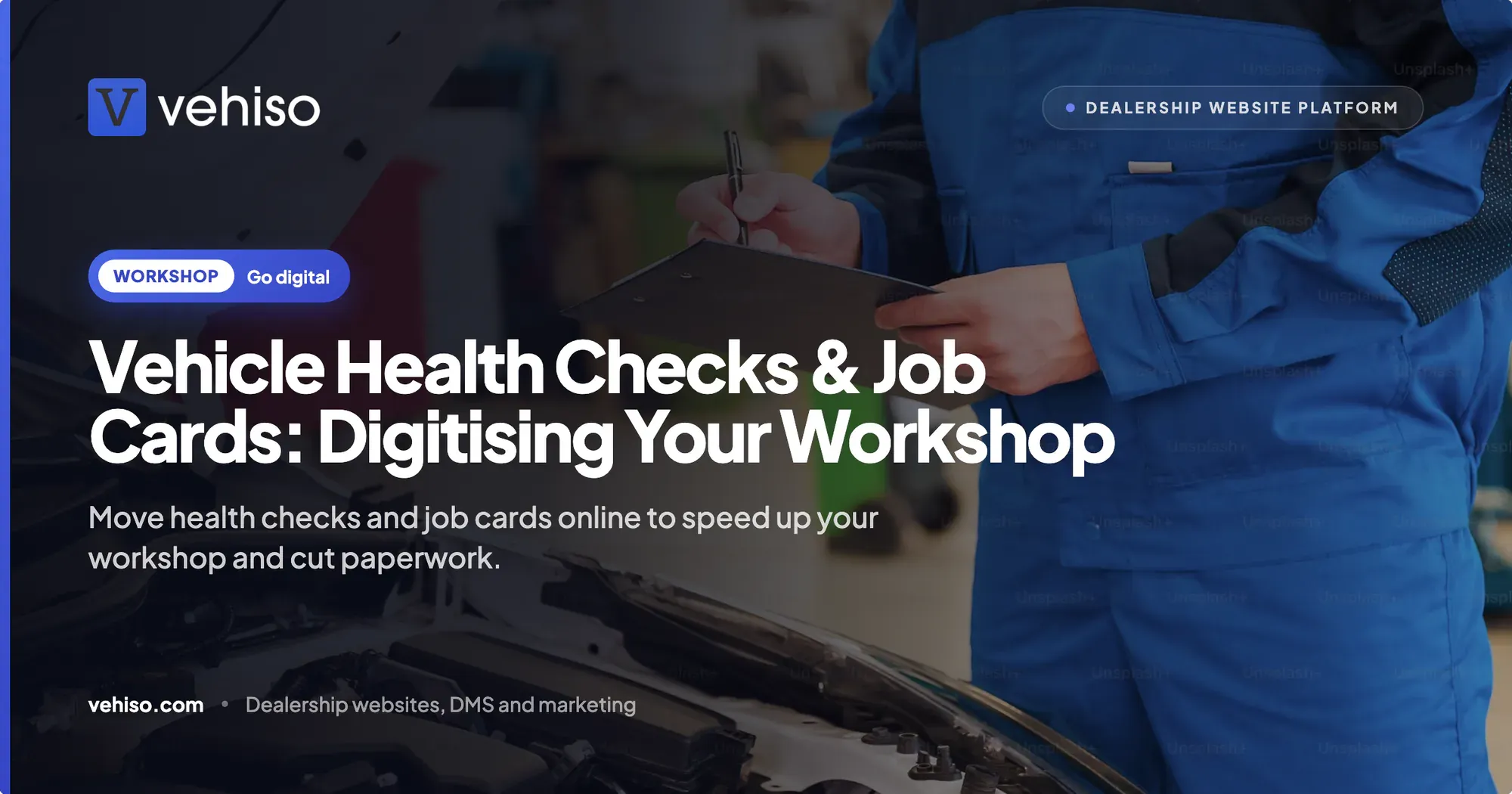
Vehicle health check software replaces the paper checklist and clipboard job card with a digital record that a technician fills in on a tablet or phone, a service advisor can share with the customer instantly, and a manager can turn into an invoice without re-typing a single line. For a dealer workshop, that means fewer disputes over what was actually checked, faster upsell of the work you find, and a proper paper trail for every vehicle that passes through the ramp - including stock going through pre-sale preparation.
If your workshop still runs on paper VHC sheets and handwritten job cards, this guide covers what digital vehicle health checks and job cards actually do, why they matter for a dealer (not just an independent garage), and how to set them up inside a dealer management system rather than bolting on yet another standalone app.
What is a digital vehicle health check (VHC)?
A vehicle health check is a structured inspection carried out when a car comes in for a service, MOT, warranty job, or pre-sale preparation. The technician works through a checklist - brakes, tyres, fluids, lights, suspension, bodywork - and grades each item, usually with a simple colour system: green for fine, amber for advisory, red for needs attention now.
A digital VHC does the same job on a tablet or phone instead of a paper pad. The technician taps through the checklist, attaches a photo or short video of anything flagged amber or red, and submits it. The service advisor sees it land on their screen in real time, can text or email a link to the customer with the photos attached, and gets a clear yes/no on each recommended repair before the customer even leaves the waiting area.
Why paper job cards are costing you money
Paper-based workshops lose money in ways that rarely show up on a single invoice but add up across a year:
- Lost upsell. A technician spots worn rear pads but there is no easy way to flag it, price it, and get sign-off before the customer collects the car. The work goes unbooked.
- Disputed work. Without a timestamped record and photos, "you said this needed doing" turns into a he-said-she-said conversation at the front desk.
- Duplicate typing. A technician writes findings on a card, the advisor re-keys them into an invoice, and errors creep in between the two.
- No audit trail. When a warranty claim or a customer complaint comes in six months later, a paper card in a filing box is slow to find and easy to lose.
- Stock prep gaps. Cars going through reconditioning before sale get the same rushed, unrecorded once-over as a routine service, so faults surface after the sale rather than before.
How digital VHCs and job cards work together
The health check and the job card are not two separate jobs, they are two stages of the same workflow when the software is built that way:
- Booking. The vehicle is booked into the workshop diary against its registration, pulling in existing customer and vehicle history if the car is already in the system.
- Health check. The technician runs the digital VHC against the vehicle, grading each item and attaching photos of anything flagged.
- Customer approval. The advisor sends the findings to the customer with pricing for any amber or red items, and the customer approves or declines each line.
- Job card. Approved work becomes the job card automatically, listing parts, labour, and time, with nothing needing to be retyped from the health check.
- Invoice. Once the work is done, the job card converts straight into a workshop invoice, ready to send or take payment against on the spot.
That single flow - booking, health check, approval, job card, invoice - is what "digitising the workshop" actually means in practice. It is not just replacing a paper form with a digital one, it is removing every point where information had to be copied by hand from one document to another.
The real benefits of digitising vehicle health checks and job cards
Transparency with customers
Photos and video attached to a health check finding do more to build trust than any amount of explaining at the counter. A customer who can see a worn tyre or a corroded brake line on their own phone is far more likely to approve the work, and far less likely to feel they have been sold something they did not need. It also protects the dealer: if a customer declines a red item and something fails later, there is a dated record showing they were told.
Higher upsell conversion on identified work
The single biggest commercial reason to move to digital VHCs is upsell. Work that is found but never quoted is revenue left on the table. When the health check flows straight into a priced quote the advisor can send in seconds, dealers typically see a meaningfully higher proportion of amber and red findings converted into booked work, simply because the friction between "we found something" and "here is what it costs" has been removed.
Technician efficiency
Technicians spend less time on paperwork and more time on the ramp. A structured checklist on a tablet is faster to complete than a paper form, especially with photo capture built in rather than needing a separate camera or phone and then matching photos to the right card afterwards. Because the health check populates the job card automatically, nobody on the shop floor is re-writing the same information twice.
Record-keeping that actually holds up
Every health check, job card, and invoice is stored against the vehicle and the customer, searchable by registration at any point later. That matters for warranty claims, for service history at resale, and for demonstrating due diligence if a customer disputes work months after the event. A digital record with a timestamp and photos is a far stronger position than a paper card that may or may not still be on file.
Tying the workshop to stock preparation
For dealers, the workshop is not only servicing customer cars, it is also where part-exchanges and new stock get prepared for sale. Running incoming stock through the same digital vehicle health check used for customer servicing means every car listed for sale has a documented inspection behind it - useful for pricing accurately, for spotting problems before a customer test-drives the car, and for having a clean record to point to if a buyer questions the car's condition after purchase. It also means reconditioning costs get logged against the vehicle properly instead of disappearing into a general workshop expense line.
What to look for in vehicle health check software
Not all vehicle health check software is built the same way, and a lot of it is designed as a standalone app that a workshop then has to connect to a separate invoicing or DMS system. Before choosing a tool, check it covers:
- Photo and video capture built into the checklist, not a separate step.
- Customer-facing approval sent by text or email with clear pricing, not just an internal note.
- Automatic job card creation from approved findings, so nothing gets re-typed.
- Direct invoicing from the completed job card, ideally with online payment built in.
- Vehicle and customer history shared with the rest of the dealership, not siloed in the workshop app.
- Reporting on upsell conversion, so you can see how much identified work is actually being booked.
That last point is where a lot of standalone VHC tools fall short: they show you what was found, but not what happened next.
How Vehiso handles vehicle health checks, job cards, and workshop invoicing
Vehiso's workshop management tools sit inside the same dealer management system that runs your stock, customer records, and sales, rather than as a bolt-on app that needs its own login and its own data. In practice that means:
- Technicians run digital vehicle health checks against a vehicle already held in the DMS, with photo capture built into each checklist item.
- Advisors send customers a clear, priced summary of amber and red findings for approval, without leaving the same screen used for the rest of the customer's record.
- Approved work turns into a job card automatically, and the completed job card converts directly into a workshop invoice, with online payment options available at the point of collection.
- Because the workshop shares data with stock and sales, a health check run on an incoming part-exchange feeds straight into that vehicle's reconditioning cost and sale-readiness, instead of living in a separate system.
Workshop management is available on Vehiso's paid plans, starting at £49 a month on the Starter plan, alongside the rest of the DMS - stock management, customer and enquiry handling, and reporting - which is included on every plan, even the free one. There's a 7-day free trial on paid plans if you want to run a real health check and job card through the system before committing.
If you're weighing up workshop tools against the rest of your day-to-day DMS tasks, it's worth reading how a dealer management system handles the wider list of daily dealership tasks, and for a fuller walkthrough of the workshop side specifically, see our guide to workshop management for car dealers.
Frequently asked questions
What is a vehicle health check (VHC) in a car dealership or garage?
A vehicle health check is a structured inspection carried out when a car comes in for a service, MOT, or repair. The technician checks items like brakes, tyres, fluids, and suspension, and grades each one, usually green, amber, or red, so the customer knows what is fine and what needs attention.
How does digital vehicle health check software improve customer trust?
Digital VHC software attaches photos and video to each finding and sends them straight to the customer with clear pricing, rather than relying on a verbal explanation at the counter. Customers can see exactly what was found, which reduces disputes and makes them more comfortable approving the work.
Can job card software actually make technicians faster?
Yes. A digital job card that is created automatically from an approved health check removes the need to re-write findings by hand, so technicians spend less time on paperwork between jobs and more time on the ramp.
Do I need separate software for health checks, job cards, and invoicing?
No, and it's usually a mistake to run them separately. When health checks, job cards, and invoicing sit inside the same dealer management system, work found during an inspection can be approved, turned into a job card, and invoiced without being re-typed at each stage.
How much does vehicle health check and workshop management software cost?
Pricing varies by provider. On Vehiso, workshop management including digital vehicle health checks and job cards is included on paid plans starting at £49 a month, with the rest of the dealer management system bundled in.
Does a digital vehicle health check help with used car stock preparation?
Yes. Running part-exchanges and incoming stock through the same digital VHC used for customer servicing gives you a documented inspection and reconditioning record for every car before it's listed for sale, which helps with accurate pricing and reduces post-sale disputes.