
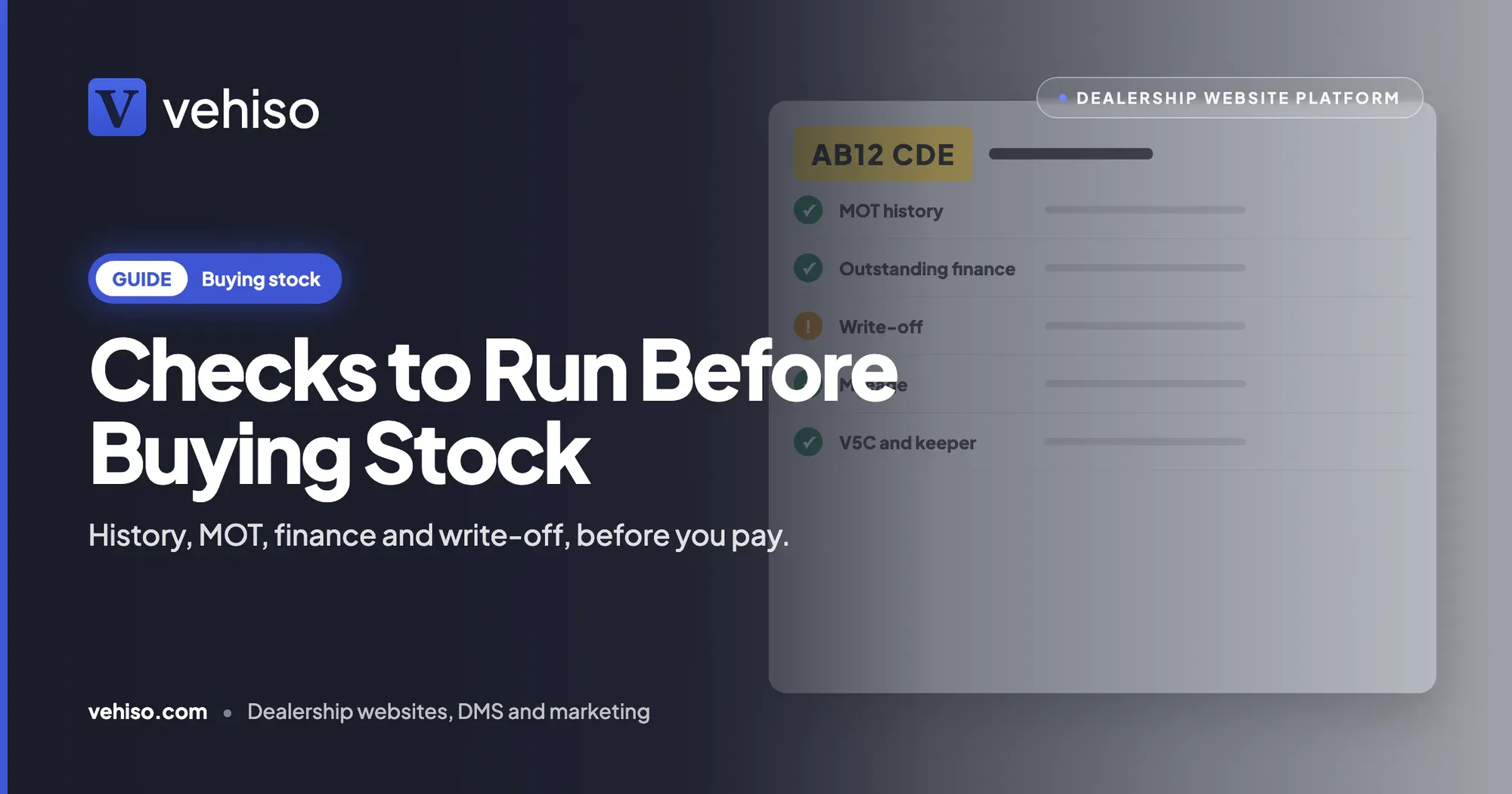
Before you buy a vehicle for stock, check five things: outstanding finance, insurance write-off status, stolen markers, MOT and mileage history, and that the V5C and VIN match the vehicle in front of you. The free gov.uk services cover MOT history, recalls and the DVLA record, but finance, write-off and stolen checks need a paid history report. Finance matters most, because the law that protects private buyers of vehicles with outstanding finance does not protect motor dealers.
This is general guidance, not legal advice.
Why the trade carries more risk than the public
Most buyers of used vehicles have some protection if the seller had no right to sell. Dealers have less, and that shapes how carefully you need to check.
The Hire Purchase Act 1964, Part III lets a private purchaser who buys in good faith, without knowing about a hire purchase or conditional sale agreement, take good title to the vehicle. A trade or finance purchaser, meaning someone who carries on a business of buying and selling vehicles or providing finance for them, gets no such protection. If you buy a vehicle that is still on hire purchase, the finance company can generally recover it from you, and you are left chasing the seller for your money.
That is why a finance check before you pay is not optional for a dealer. It is the single most expensive check to skip.
The free checks on gov.uk
The government's own guide, check a used vehicle you're buying, lists the official checks. All of them are free.
The DVLA record. The vehicle information check shows tax status, SORN status, MOT expiry, date of first registration, the date the last V5C was issued, year of manufacture, engine size, fuel type, emissions and export status. Check that it matches what you have been told. A colour, engine size or first registration date that does not match is a reason to stop and ask why.
MOT history. The MOT history service shows each test result, whether it passed or failed, the mileage recorded at the test and, in England, Scotland and Wales, what failed and any minor problems noted. It covers car and van tests done since 2005, and Northern Ireland tests since 2017.
Recalls. The vehicle recall checker shows whether the manufacturer has recalled the vehicle for a serious safety problem, and whether a recall is still unfixed.
What the free services do not tell you is just as important. None of them shows outstanding finance, insurance write-off records or whether the vehicle is recorded as stolen. For that you need a paid history report.
Outstanding finance
A vehicle on hire purchase or conditional sale belongs to the finance company until the agreement is paid off. Personal contract purchase agreements are usually set up as one of these, so treat them the same way.
How to check. A paid history report from a check provider will show whether a finance agreement is registered against the vehicle and, usually, who the lender is.
What to do if finance shows. Do not pay the seller and hope. Get a settlement figure from the lender, pay the lender directly to clear it, and pay any balance to the seller. Keep written confirmation from the lender that the agreement is settled. If the seller will not let you contact the lender, walk away.
Part exchanges count. A customer trading in a vehicle with finance is common and perfectly normal, as long as the settlement is handled properly. The risk is the trade-in where nobody asked.
Insurance write-offs: Cat A, B, S and N
When an insurer decides a damaged vehicle is not worth repairing, it gets a category. Gov.uk sets them out as follows:
Category A. Cannot be repaired. The entire vehicle has to be crushed.
Category B. Cannot be repaired. The body shell has to be crushed, but other parts can be salvaged.
Category S. Can be repaired following structural damage. It can be used again if repaired to a roadworthy condition.
Category N. Can be repaired following non-structural damage. It can be used again if repaired to a roadworthy condition.
A Category A or B vehicle should never be in your retail stock. A Cat S or Cat N vehicle can legally be sold once properly repaired, but the category stays on the vehicle's record, it affects its value, and the buyer has to be told. Failing to mention a write-off category is a textbook misleading omission under consumer protection law, which since 6 April 2025 sits in the Digital Markets, Competition and Consumers Act 2024 (CMA guidance). For a Cat S vehicle, DVLA records the category on the V5C.
Write-off markers come from insurers and appear on paid history reports, not on the free DVLA check.
Stolen vehicles and cloned identities
Stolen markers. A paid history report will flag a vehicle recorded as stolen. If it does, do not buy it and do not hand it back to the seller. Contact the police.
The V5C itself. Gov.uk advises checking that the V5C has a "DVL" watermark and that its serial number is not in the ranges BG8229501 to BG9999030 or BI2305501 to BI2800000. Documents in those ranges may be stolen blanks, and gov.uk says to call the police if you see one.
VIN and engine number. Check the vehicle identification number on the vehicle against the V5C, and the engine number too. A cloned vehicle wears the identity of a legitimate one, so the registration can come back clean on every check while the vehicle in front of you is something else. The VIN on the vehicle is how you catch it. Check more than one location, and look for signs that a VIN plate has been tampered with.
V5C and keeper checks
See the V5C. Gov.uk says you need to see the V5C before buying. A seller who cannot produce it, or has "just sent it off", is a reason to slow down.
Match the seller. The name and address on the V5C should match the person selling to you, or there should be a clear explanation, for example a company vehicle or a deceased relative's estate. Ask for ID and check the address.
The V5C issue date. The V5C issue date should match the DVLA record. A very recent issue date on a vehicle with a long history is worth asking about.
Mileage
Mileage tampering, or clocking, is still a real problem, and a buyer who later finds the mileage is wrong will come back to you.
Use the MOT history. Every MOT records the odometer reading. Look for a reading that goes down between tests, or a long gap followed by an implausibly low reading.
Compare it with everything else. Service stamps, invoices, old MOT certificates and the wear on the vehicle should tell the same story as the odometer.
Disclose honestly. If you cannot verify the mileage, say so clearly in writing. Advertising a mileage you have reason to doubt is a misleading action under consumer protection law.
Making checks part of the buying routine
Checks are worth most before money moves, while they can still change your decision. Run them before you bid, before you agree a part exchange figure, and on arrival for anything bought unseen. Keep the report with the vehicle record, so that if a buyer or trading standards ever asks what you knew and when, the answer is on file.
In Vehiso, the dealer management system keeps each vehicle's documents with its record, and on paid plans you can connect your own MotorCheck trade account to run history checks from the vehicle and file the report against it automatically. We explain how in connect MotorCheck to Vehiso. Once the vehicle passes its checks, the preparation board takes it from purchase to the forecourt, and market price comparisons help you check the price you paid against what similar vehicles are advertised for.
Frequently asked questions
Do dealers get good title to a vehicle with outstanding finance? Generally no. Part III of the Hire Purchase Act 1964 protects private purchasers who buy in good faith, but not trade or finance purchasers. If a dealer buys a vehicle that is still subject to a hire purchase or conditional sale agreement, the finance company can usually recover it, so always check for finance and settle it directly with the lender before paying the seller.
Can I sell a Cat S or Cat N vehicle? Yes, once it has been properly repaired to a roadworthy condition. Category S and N vehicles can legally be used and sold again, but you must tell the buyer about the category clearly before the sale, as leaving it out is likely to be a misleading omission. Category A and B vehicles cannot be repaired and should not be retailed.
What can I check for free on gov.uk before buying a vehicle? You can check the DVLA vehicle record (tax, MOT expiry, first registration, last V5C issue date and more), the full MOT history including recorded mileages, and whether the vehicle has an outstanding safety recall. These checks do not show outstanding finance, insurance write-offs or stolen markers, which need a paid history report.
How do I spot a clocked vehicle? Compare the odometer reading with the mileages recorded on each MOT in the gov.uk MOT history, and with service records and invoices. A reading that drops between tests or does not match the paperwork is a warning sign. If you cannot verify the mileage, say so in writing to the buyer.
What V5C checks should I do before buying stock? Check the V5C has a "DVL" watermark, that its serial number is outside the ranges gov.uk lists as possibly stolen, that the details match the DVLA record, and that the VIN and engine number match the vehicle. Make sure the seller is the registered keeper, or has a clear and verifiable reason for not being.