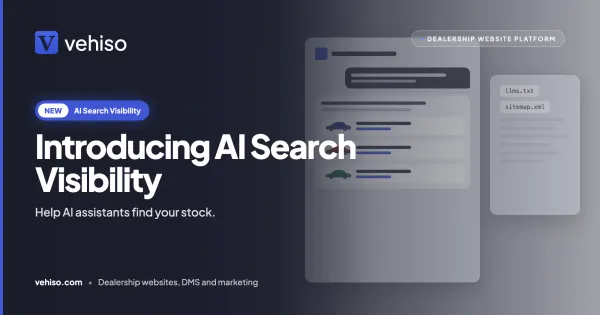

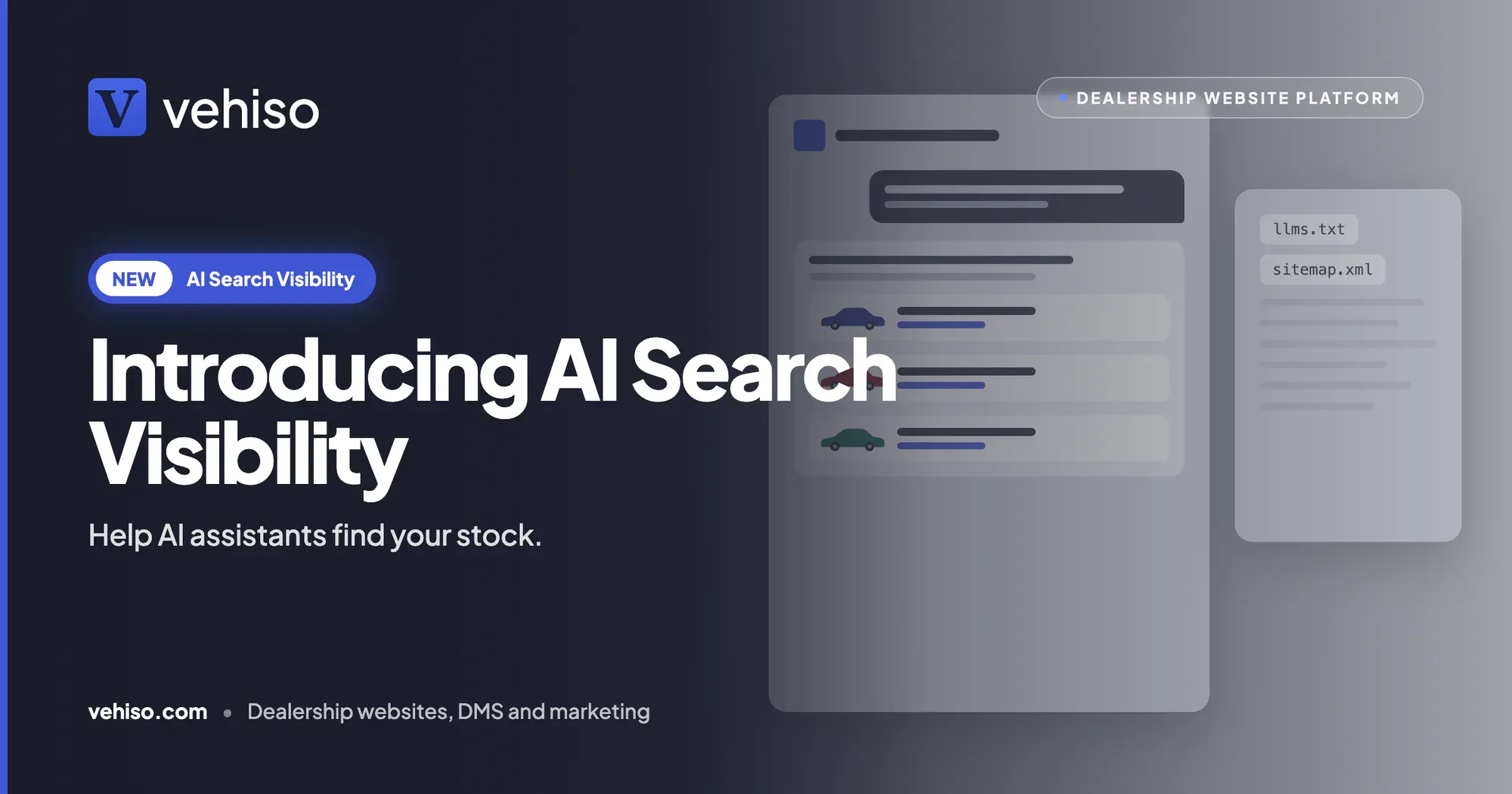
A buyer is sat on the sofa with their phone. They do not open a search engine and scroll through ten blue links. They type a question into an AI assistant instead. "Where can I find a reliable automatic hatchback under ten grand near me? Somewhere that takes part exchanges." AI search visibility helps make sure your dealership can be part of the answer.
The assistant answers in a paragraph. It names a couple of dealers, mentions a car or two, and the buyer taps through.
The question every dealer should be asking is simple. When that assistant went looking, could it actually read your website? Or did it find a page of photos, a price buried in a slideshow, and no clear answer to whether you take part exchanges at all?
More buyers now ask assistants such as ChatGPT, Google AI Mode and Claude where to find their next vehicle. Those assistants can only recommend what they can understand. So every Vehiso dealer website is now built to be read by them.
What AI search actually is
It is worth being plain about this, because the phrase gets thrown around.
AI search means assistants that answer a buyer's question directly, instead of showing a list of links. When they suggest dealers or vehicles, they rely on what they can read on dealers' websites.
That last part is the bit that matters to you. An assistant is not driving past your forecourt. It is reading your website, and if your website does not say something clearly, the assistant either guesses or moves on to a dealer whose site does.
What AI search reads on your website
AI search visibility works in the background of every Vehiso dealer website. There are three parts to it.
Your stock, always current. Your website publishes a live list of the vehicles you have for sale, with prices, mileage and links. AI search can read that list directly, without having to piece it together from your vehicle pages one at a time.
A summary of your business. A plain-language summary of your dealership sits on your website for AI assistants to read: where you are, how to get in touch and what you sell.
Answers in your own words. Answer the questions buyers ask most, and your answers appear on a page of your website and in the information search engines and AI assistants read.
The first two need nothing from you. The third is the one part you add to, and there is more on it below.
Built to be found
Underneath those three parts is the groundwork that search engines and AI search both depend on. It is done for you.
A live stock list. New vehicles appear and sold ones drop off as your stock changes. That means AI assistants are not sending buyers to a car you sold last Tuesday, which is a poor first impression for everybody involved.
Every vehicle listed for search. Each vehicle page is listed for search engines, so new stock is found quickly rather than waiting to be stumbled upon.
Understood, not just shown. Vehicle pages and your answers are labelled so search engines and AI assistants understand what they are, not just display them. A price is marked as a price. A question and its answer are marked as a question and its answer.
Nothing to maintain. It all updates from the stock and details you already keep in the Vehiso DMS. You are not keeping a second list anywhere.
If you want the wider picture of how dealer websites get found, our guide to car dealer website SEO covers the traditional side, and vehicle stock pages that convert covers what buyers need once they land.
The buyer questions page
This is the part worth ten minutes of your time.
Buyers ask the same handful of questions before they get in touch. Do you deliver? Do you take part exchanges? Do you offer finance? What warranty comes with the car? Can I book a test drive at the weekend?
If your website answers those clearly, a buyer gets the answer before they pick up the phone. And so does any AI assistant reading your site on their behalf.
You manage your answers under Administration > Website > Buyer Questions in the Vehiso DMS. You start from suggested questions about delivery, part exchanges, warranties, finance and test drives, and you write the answers yourself.
A few things about how it behaves:
An answer only appears once you publish it. Drafts stay drafts until you say otherwise.
The page goes live once one answer is published. Until then, there is no half-empty page sitting on your website.
It has its own address on your website. You can add it to your menu so buyers find it as easily as assistants do.
Edit or unpublish at any time. Change an answer, or take one down, and your website follows within minutes.
Your words, not invented ones
Here is the line we drew, and why.
AI search repeats what your website says. So your website should say exactly what you mean.
That is why answers to buyers' questions are only ever written by you, never made up for you. The suggested questions help you start, but every answer is yours, because buyers, search engines and AI assistants read it exactly as you wrote it.
Think about what an invented answer could do. "Yes, we deliver nationwide" sounds helpful until a buyer in the far north of Scotland takes you at your word. "Finance available" means something different to every dealer. A sentence you did not write, repeated by an assistant to a buyer you have never met, is a sentence you will end up having to explain.
So you write it. Keep it short, keep it true, and keep it in the voice you would use on the phone.
Search welcome, scrapers not
There is another side to being easy to read: being easy to copy.
Your website asks scraping and copying tools to stay away by default, while search engines, AI search and social media link previews are still welcome. So the assistant a buyer is using can read your stock, and the link preview still shows when someone shares your car on social media, but tools that exist to lift your stock and photos are asked to leave it alone.
If you would rather open your website to every crawler, you can, from your website settings.
A few honest limits
Nobody can guarantee a recommendation. Not us, not anybody. What Vehiso does is make sure that when an AI assistant looks, it finds your current stock and your own answers clearly laid out, rather than having to guess. Which dealers an assistant chooses to mention is up to the assistant.
Your answers are only as good as what you write. The buyer questions page does nothing until you publish at least one answer, and a vague answer gets repeated vaguely. If you offer part exchanges but not on vans, say so.
Asking scrapers to stay away is a request. Reputable tools respect it, but it cannot physically stop every one.
Your stock data still matters. The live stock list reads from the DMS. A car with the wrong mileage or a missing price is published that way, to assistants and buyers alike.
Which plan it is on
AI search visibility is part of every Vehiso dealer website, on every plan, the free one included. There is nothing to set up and nothing extra to pay.
The stock list, the business summary and the listing of your vehicle pages are there from the moment your site is live. The buyer questions page is the one part you add to, by writing your answers in the DMS.
The free plan covers up to five vehicles and one user, with the dealer management system included, so you can put real cars on a real website and see how it reads. The full comparison is on the pricing page.
Where it fits
AI search visibility helps buyers find you. What happens once they arrive is a different job.
The AI website assistant answers buyers' questions on your site in a chat, from your stock. And if you use an AI assistant yourself, you can now connect Claude, ChatGPT and other assistants to your dealership and ask about your stock and enquiries in plain English.
Buyers will keep asking assistants where to find their next car. Make sure the answer can include you. Read more about AI search visibility, then open Buyer Questions in your DMS and write your first answer today.