

I've spoken to a lot of independent dealers over the years building Vehiso, and one problem comes up again and again. It's not advertising. It's not finance. It's keeping track of who is coming in, when they're coming, and what they're coming for.
If you're running a small dealership - maybe just you or you and one other person - you already know how easy it is to lose track. You're out on a test drive and someone rings to book a viewing. You scribble it on a Post-it note. That note ends up under a stack of V5s. The customer turns up and you've completely forgotten.
That's a missed sale. And it happens far more often than most dealers would admit.
The real problem with running a dealership from memory
When you're wearing every hat in the business - sales, admin, valeting, photography, delivery driver - your brain is not a reliable diary. I don't say that as a criticism. It's just reality. Nobody can hold a full day of appointments, follow-up calls, and handover schedules in their head while also trying to sell cars.
Here's what I see happening at dealerships that don't have a proper system:
Double-bookings. Two customers turn up for the same car at the same time. One of them is going home disappointed, and they're probably not coming back.
Missed handovers. A customer has paid for their car, they've arranged collection for Saturday morning, and nobody at the dealership remembered. The car hasn't been valeted. The paperwork isn't ready. That customer is telling everyone they know about the experience.
Forgotten follow-ups. A buyer came in last week, liked a car but wasn't ready to commit. You said you'd call them on Monday. It's now Thursday and they bought from someone else.
Part-exchange chaos. A customer is dropping off their part-exchange on Wednesday so you can inspect it before completing the deal. Nobody wrote it down. The customer arrives and you're out doing a delivery.
Every single one of these situations costs you money. Some of them cost you reputation, which is worse.
What a dealer diary system should actually track
A lot of dealers think of a diary as just a list of appointments. But if you're going to use one properly, it needs to cover everything that has a time attached to it. That includes:
- Test drive bookings - who, when, which car
- Vehicle viewings - even if it's a casual "I'll pop in Thursday afternoon"
- Handovers and collections - the customer is expecting a smooth experience
- Part-exchange drop-offs - so you're ready to inspect and value the vehicle
- Service and MOT appointments - if you offer servicing or prep work
- Follow-up calls and reminders - the calls that actually close deals
- Internal tasks - vehicle prep, photography, valeting, moving stock around
That last one is easy to overlook. But if you've promised a customer their car will be ready by Friday, and nobody scheduled the valet and the photo shoot, you're going to be scrambling.
How to use a diary system effectively
Having a diary is one thing. Actually using it properly is another. I've seen dealers set up systems and then ignore them within a week because they didn't build the habit. Here's what works:
Book everything immediately
The moment a customer calls, texts, or walks in and arranges something, put it in the diary. Not later. Not when you get back to the office. Right then. "I'll add it later" is how things get forgotten.
Include the details that matter
Don't just write "viewing at 2pm." Write the customer's name, their phone number, and which vehicle they're coming to see. If they mentioned anything specific - like wanting to bring their partner, or needing finance information - note that too. When you look at your diary the next morning, you should know exactly what's happening and how to prepare.
Set reminders
A diary entry without a reminder is just a record. Set a reminder for the morning of each appointment, or the day before for anything that needs preparation. A handover needs the car valeted, paperwork printed, and keys ready. That prep doesn't happen by accident.
Review your diary every morning
Before you do anything else, look at what's booked in for the day. This takes two minutes and saves you from being caught off guard. It also lets you spot clashes before they become problems.
Make sure your team can see it
If you have staff - even one other person - they need access to the same diary. If your appointments live in your personal phone and you're off sick, nobody knows what's happening. A shared diary means anyone at the dealership can greet a customer and know exactly why they're there.
Paper diary vs phone calendar vs dealer management system
Most dealers fall into one of three camps. Let me break down the pros and cons of each.
Paper diary
The classic desk diary. Simple to use, no tech skills required.
But paper diaries can't send you reminders. They can't be shared between staff unless everyone is standing at the same desk. They get coffee spilled on them. Pages get torn out. And if you lose it, everything is gone.
Paper works if you're a one-person operation doing two or three appointments a week. Beyond that, it starts falling apart.
Google Calendar or phone calendar
This is a step up. You get reminders, you can share calendars with staff, and it's always in your pocket. A lot of dealers use this and it works reasonably well.
The problem is that your calendar is completely disconnected from everything else. When you book a test drive in Google Calendar, it's just a calendar event. It's not linked to the customer's enquiry. It's not linked to the vehicle they want to see. If you want to check what car they asked about, you're digging through emails or WhatsApp messages.
It works, but you're doing a lot of manual stitching to keep everything connected.
DMS diary (like Vehiso)
A dealer management system with a built-in diary solves the disconnection problem. When you book a test drive in Vehiso, you're selecting the customer from your enquiry list and the vehicle from your stock. Everything is linked.
That means when you look at tomorrow's appointments, you can see:
- The customer's name and contact details
- Which vehicle they're interested in
- Their full enquiry history - what they've looked at before, what they've been quoted
- Whether they need finance, have a part-exchange, or have any special requirements
You're not just seeing "John - 2pm." You're seeing the full picture, and you can prepare properly.
How Vehiso's diary works
I built the diary in Vehiso because I kept hearing the same frustrations from dealers. They wanted something simple, but connected to the rest of their business. Here's what it does:
Book test drives, viewings, handovers, and custom events. Whatever type of appointment you need, you can create it. Each one is linked to the relevant customer and vehicle record.
Linked to customer records and vehicle stock. Click on any appointment and you can see the customer's full history and the vehicle details. No digging through separate systems.
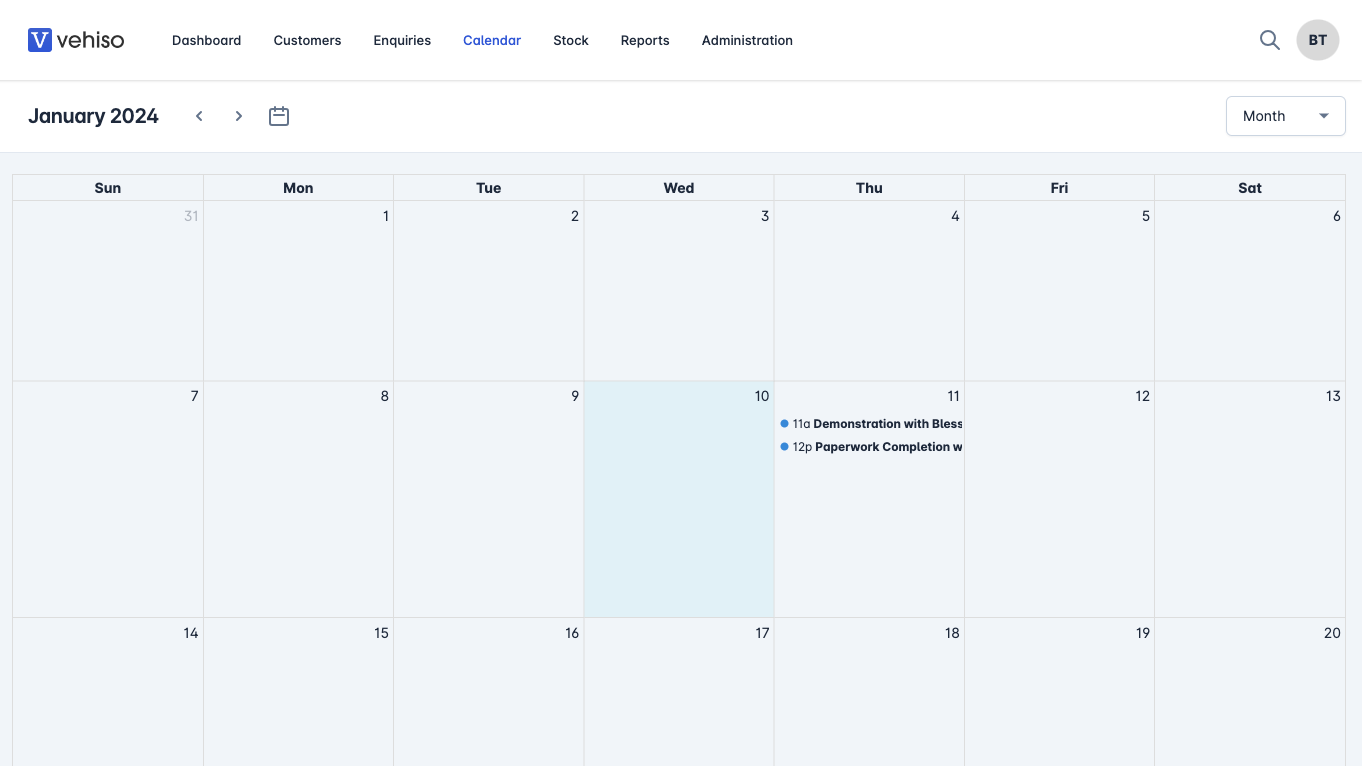
Dashboard and calendar views. See your day at a glance on the dashboard, or switch to a full calendar view for the week or month ahead.
Visible to all team members. Everyone at your dealership sees the same diary. No more "I didn't know they were coming in."
Part of the same system you already use. The diary isn't a separate tool. It's built into the same platform where you manage stock, enquiries, and sales. One login, one system, everything connected.
The cost of not having a system
Let me put some numbers to this, because it's easy to think "I manage fine without one."
One missed handover means a delayed payment and a customer who starts their ownership experience frustrated. They're not leaving you a five-star Google review.
One double-booked viewing means one of those potential buyers is turned away. If that car had a margin of £1,500, you've just risked half your potential audience for it.
One forgotten follow-up call means a warm lead has gone cold - or worse, gone to the dealer down the road who did remember to ring them back.
Now multiply those across a month. If you're doing 20-30 appointments a month and even 10% go wrong because of poor organisation, that's two or three deals at risk every single month. Over a year, the cost adds up to thousands in lost revenue and damaged reputation.
A diary system doesn't cost you anything close to what disorganisation costs you.
Getting started
If you're currently running everything from memory or a paper diary, you don't need to overhaul your entire operation overnight. Start by committing to one rule: everything gets booked in immediately, with the customer name, phone number, and vehicle.
Do that for a week and you'll already notice the difference. Then look at whether your current system - whatever it is - actually supports how you work. If it doesn't, have a look at Vehiso and see whether it fits.
Frequently Asked Questions
What is a car dealer diary system?
A car dealer diary system is a scheduling tool designed for dealerships to manage test drive bookings, vehicle viewings, handovers, follow-up calls, and other daily appointments. Unlike a general calendar app, a dealer-specific diary system connects appointments to customer records and vehicle stock so everything is in one place.
Can I just use Google Calendar for my dealership?
You can, and it's better than nothing. The limitation is that Google Calendar doesn't know anything about your customers or your stock. You'll end up with a calendar full of names and times but no connection to enquiry history, vehicle details, or sales progress. For a very small operation it can work, but most dealers outgrow it quickly.
How does a diary system help prevent double-bookings?
A shared diary system shows all appointments across your team in one view. Before booking a new appointment, you can see what's already scheduled and avoid clashes. Some systems will flag conflicts automatically. The key is that everyone is looking at the same information rather than keeping separate schedules.
Is it worth paying for a dealer management system just for the diary?
The diary alone probably isn't enough to justify a DMS. But the diary is part of a much bigger picture - stock management, enquiry tracking, sales processing, reporting. When all of those work together in one system, the diary becomes significantly more useful because every appointment is connected to everything else in your business.
How do I get my team to actually use a diary system?
Make it the rule, not the exception. If an appointment isn't in the diary, it doesn't exist. Review the diary together at the start of each day. When someone forgets to log a booking and it causes a problem, use that as the reason to reinforce the habit. Most people adopt it within a couple of weeks once they see the benefit.


